Leapfrog
XAUUSD · M15 · MetaTrader 5 Expert Advisor
Coming soon. This Expert Advisor is in final testing and is not for sale yet. Its description, manual and research are published so you can follow it before release.
Read the manualHow it was built
Headline backtest
Profit factor 1.66 · worst equity drawdown 7.3% · 3,922 trades · return x3.02 on 10,000
Backtest, real ticks, Fusion Markets, 2024-01-02 to 2026-09-26, default settings, version 1.30. The weakest of the live brokers tested, not the strongest.
Figures on this page come from the MetaTrader 5 Strategy Tester on real broker ticks. They are backtests, not live results.
Leapfrog is an MT5 Expert Advisor for gold (XAUUSD) that trades range breakouts on five rolling ranges at once. Each "ladder" watches the highest high and lowest low of its own rolling time window - about one day, about 30 hours, about 56 hours, about three days, and about four trading weeks - and rests a stop order just beyond that window's edge, so a genuine break of the range fills it in the direction of the move.
How a trade is made:
Range. Each ladder keeps its own rolling high and low over its own window. Four windows are measured in hours; the longest is measured in trading days.
Entry. A stop order rests a small percentage of price beyond the range edge and is re-aimed as the range moves. Orders are placed only at fixed clock slots, not on every tick, and each ladder holds at most one position per side at a time.
Risk per trade. Every order carries a hard stop loss from the moment it is placed, set as a percentage of the gold price. Position size is computed from account value and a lot-per-10,000 setting, shared per ladder.
Exit. Once a position is in profit the exit engine closes part of it in three stages and then trails the stop behind the best price reached. There is no averaging down, no grid and no martingale; a losing position is closed at its stop.
When it does not trade. Two self-calibrating controls read gold's own recent volatility rather than a fixed number. New orders are not armed when the prior day's volatility sits at either extreme of its own recent history, and position size is scaled down, not switched off, when the shorter-term range is unusually narrow. Orders are removed before the weekend.
What the EA does not do: no grid, no martingale, no averaging down, no position without a stop loss, no news trading logic, no files, no DLLs, no external resources.
The five ladders share the same mechanism family as other level and range breakout systems in this catalogue, and each is built differently. One system rests a single stop order beyond one confirmed swing level and manages it with a two-stage trailing stop. Another rests several stop orders beyond the nearest unbroken swing high or low on two higher timeframes, with a fixed-dollar stop and target and a give-back exit. A third trades the breakout of a consolidation range read from three timeframes together. Leapfrog instead runs five ladders side by side, each re-arming a stop order at its own rolling window's high or low on a fixed clock rather than at a single confirmed swing point, with a percentage-of-price stop and a staged partial-close and trail exit.
Settings. One short section, "Start here", is the whole setup: Account type (Personal, Prop firm 2-step, Prop firm 1-step), Settings (Recommended, Custom), a lot-per-10,000 setting per ladder, a fixed lot, an optional balance to size on, and a maximum spread in dollars. With Settings on Recommended the tested configuration is used whatever the lower sections say, so a stray edit cannot change it; Custom opens every ladder's window, offsets, stop, target and the volatility controls for your own tests. The compiled defaults are the tested configuration; the EA needs no .set file. On a chart that is not gold it loads, says why, and stays flat.
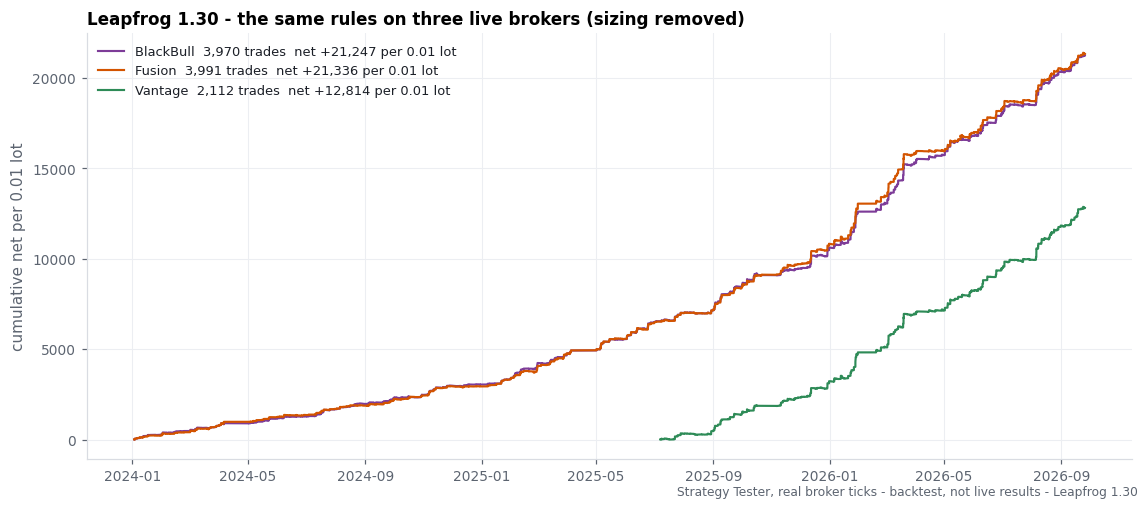
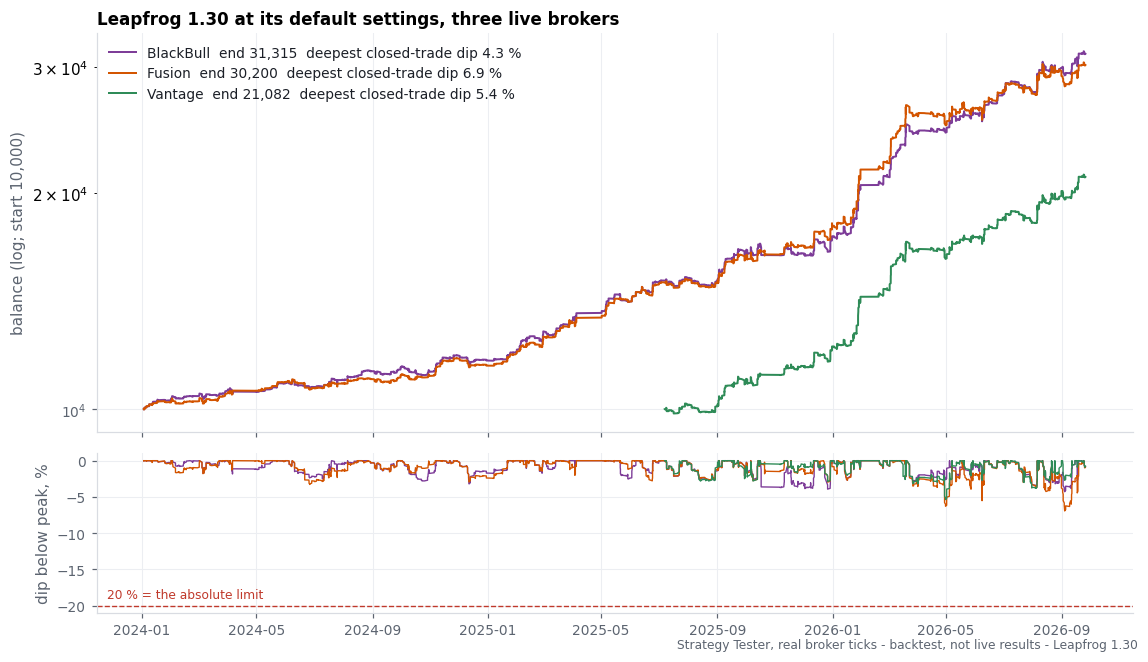
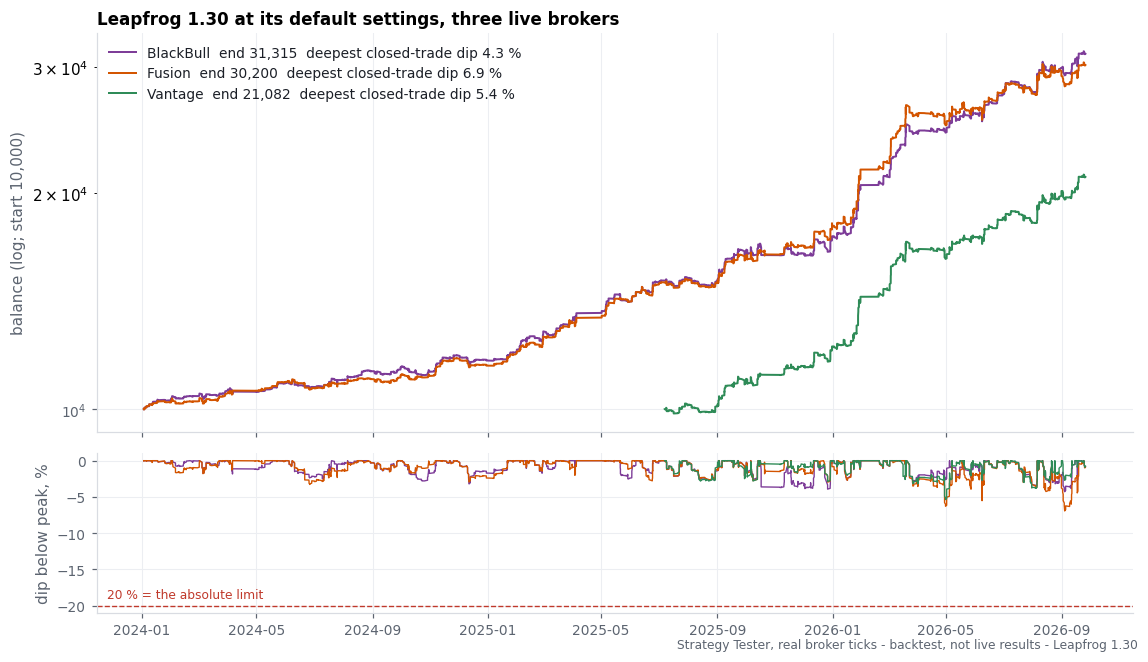
Results below are MetaTrader 5 Strategy Tester runs on real broker ticks (100 percent history quality), 10,000 starting balance, version 1.30 at its compiled defaults, and are backtests, not live trading. One binary, three live brokers, 2 January 2024 to 26 September 2026:
- Fusion Markets: profit factor 1.66, net +20,200 (+202 percent), 3,922 trades, relative equity drawdown 7.3 percent - the published figure, the weaker of the two feeds that cover the whole window
- BlackBull Markets: profit factor 1.77, net +21,315 (+213 percent), 3,909 trades, relative equity drawdown 5.7 percent
- Vantage Markets, real-tick history from July 2025: profit factor 1.80, net +11,082 (+111 percent), 2,098 trades, relative equity drawdown 5.9 percent
The two full-window feeds take nearly the same number of trades and end within about 6 percent of each other: the result is a property of the rules rather than of one broker's cost structure. Every feed shown is positive and stays under 10 percent equity drawdown.
Prop-firm accounts. Choose the Account type and nothing else. Prop firm 2-step fixes the size at 0.03 lot per 10,000 of account value per ladder for challenges with a 5 percent daily and 10 percent maximum loss; Prop firm 1-step fixes it at 0.02 for 3 percent / 6 percent challenges. Weekend protection stays on in both modes. A second input group takes your firm's own daily loss limit, maximum loss limit, profit target, best-day cap and Friday close hour; when a limit is close the EA closes its own trades, deletes its orders, and pauses until the firm's next day (daily rules) or stops for good (maximum loss, target). It is a rule guard, not a guarantee: a price gap can carry a loss past a limit, which is why the EA acts ahead of the stated limit by default. Details: user manual.
Requirements
- Gold (XAUUSD or your broker's spelling), hedging account, VPS recommended (it maintains resting orders around the clock).
- Raw-spread or ECN account preferred; the partial-profit marks are small fractions of the daily range.
- Recommended minimum 5,000 in account currency; the published figures are on 10,000. On small accounts the broker's minimum lot limits how far the sizing control can reduce a position.
- Needs 250 daily and 200 hourly bars of history to calibrate its volatility measures; on short history it trades ungated rather than standing down on missing data.
Important
All performance figures published with this product are Strategy Tester backtest results on real broker tick data. Backtests describe the past and are not a promise or a projection of future results. Trading carries risk of loss. Test on a demo account first.
This build is designed and validated for gold. On another instrument it loads and reports that it will not trade, rather than trading a market it was not validated on.
Frequently asked questions
Q: Which broker and account type does Leapfrog need? A: A hedging account - the five ladders can hold positions on both sides at once. A raw-spread or ECN account is preferred, since the partial-profit marks are small fractions of the daily range.
Q: What is the minimum deposit? A: 5,000 in account currency is the recommended minimum; the published results use 10,000. Below the recommended minimum the broker's own minimum lot limits how far the position-sizing control can reduce a trade.
Q: Which chart and timeframe do I attach it to? A: Any XAUUSD chart. Leapfrog reads its own 30-minute, hourly and daily series internally; M15 is the chart the testing used.
Q: Which setting should I start with? A: Leave Settings on Recommended in the "Start here" section. It uses the validated configuration whatever the other inputs say, so a stray edit cannot change how the EA trades; Custom is for your own testing only.
Q: Does Leapfrog use a grid, martingale or averaging? A: No. Each of the five ladders holds at most one position per side, there is no averaging down, no grid and no martingale, and a losing position is closed at its stop.
Q: Why does it sometimes not trade? A: It only fills when a rolling range actually breaks, so a quiet gold market with fewer genuine breaks means fewer trades. Two self-calibrating controls also stand new orders down when the prior day's volatility sits at an extreme of its own recent history.
Q: Can I use Leapfrog on a prop-firm account? A: Yes. The Account type setting has Prop firm 2-step and Prop firm 1-step options sized for those challenge rules, plus a separate input group for your firm's own daily loss, maximum loss, profit target and Friday-close numbers.
Evidence