Captain Karat-Smash
XAUUSD · H1 · MetaTrader 5 Expert Advisor
Coming soon. This Expert Advisor is in final testing and is not for sale yet. Its description, manual and research are published so you can follow it before release.
Read the manualHow it was built
Headline backtest
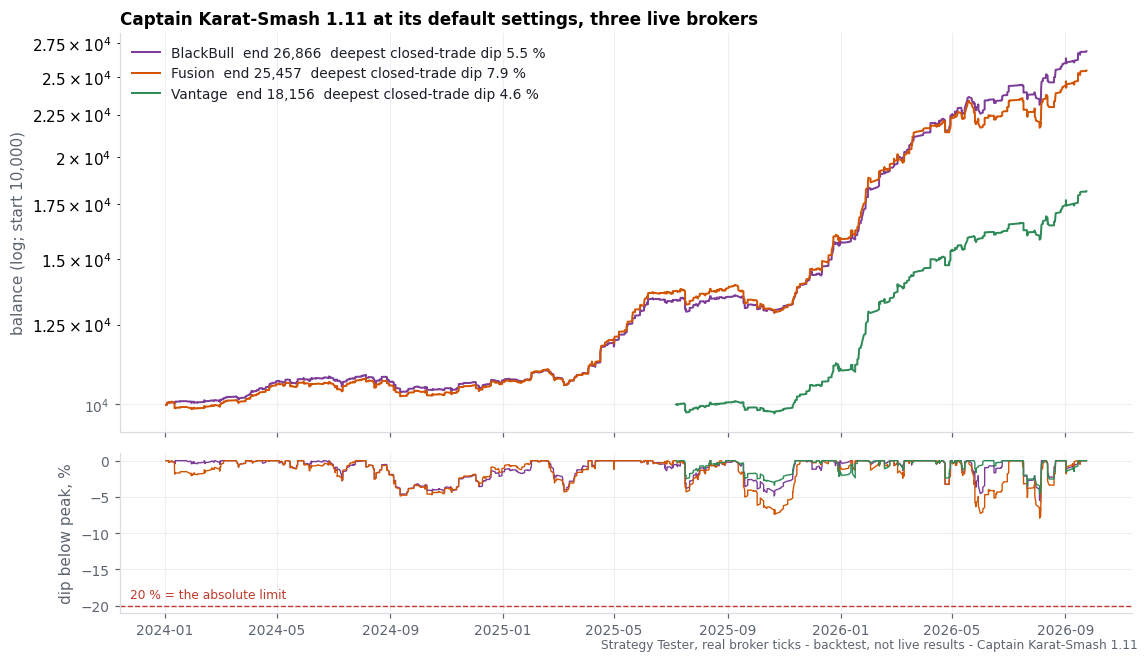
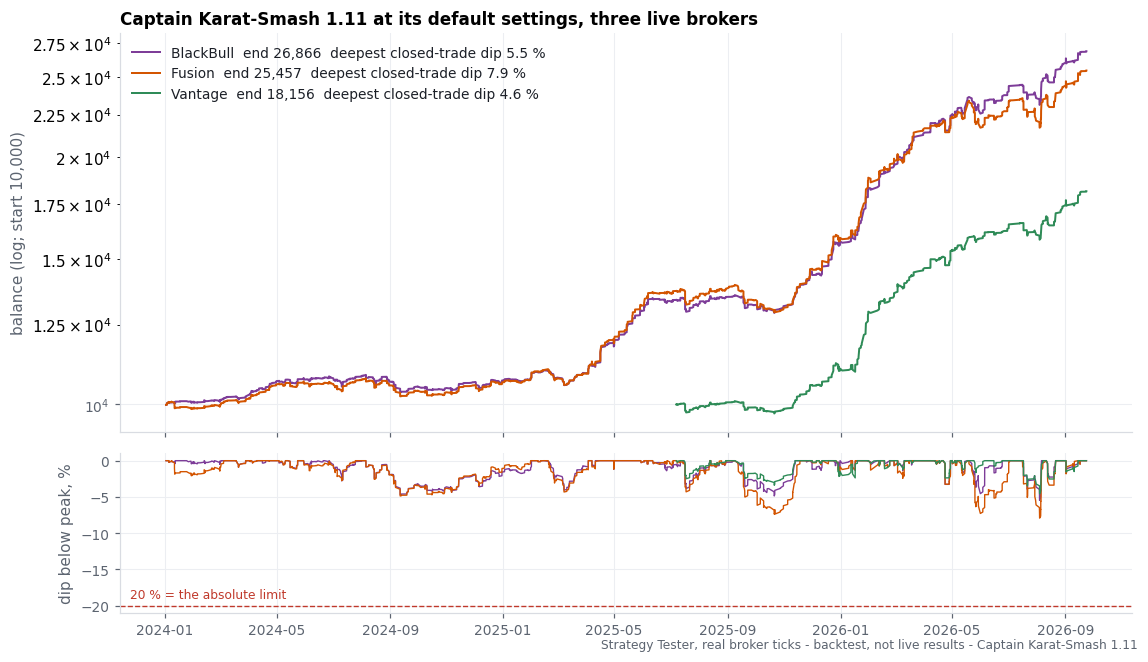
Profit factor 1.88 · worst equity drawdown 8.7% · 2,119 trades · return x2.55 on 10,000
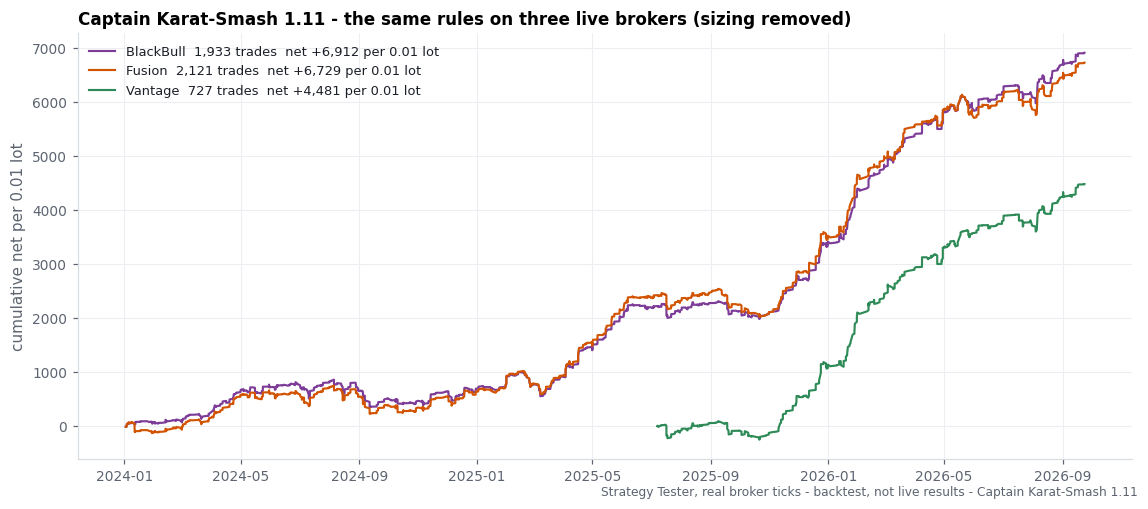
Backtest, real ticks, Fusion Markets, 2024-01-02 to 2026-09-26, default settings, version 1.11. The weakest of the live brokers tested, not the strongest.
Figures on this page come from the MetaTrader 5 Strategy Tester on real broker ticks. They are backtests, not live results.
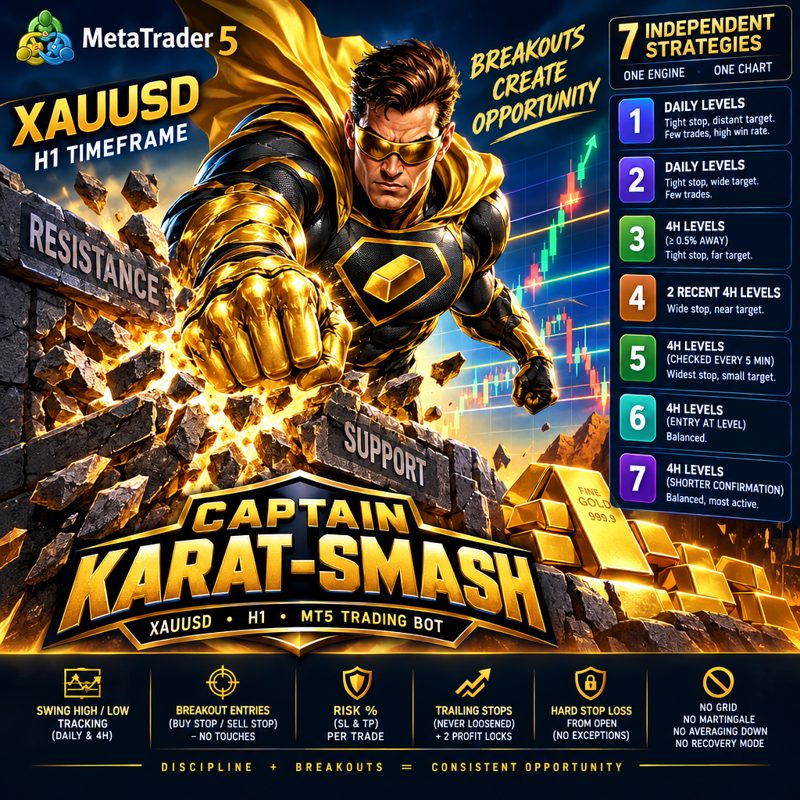
Captain Karat-Smash is an MT5 Expert Advisor for gold (XAUUSD): a support and resistance breakout system that runs seven independent strategies on one H1 chart. He waits for the walls of consolidation to close in, then punches through the level and takes what is on the other side. Seven independent strategies run side by side on a single H1 chart. They share one engine and differ in the timeframe they read, how strict their level definition is, and how their stop loss and take profit are proportioned.
How a trade is made:
Level. Each strategy tracks the most recent unbroken swing high above price and swing low below it. A swing is a bar whose high or low is more extreme than the bars on both sides of it and which no closed bar has traded through since. Strategies one and two read daily bars, the others read four-hour bars.
Entry. A buy stop order rests just inside the swing high and a sell stop order just inside the swing low. Price has to carry through the level for the order to trigger, which distinguishes a break from a touch. Orders that are not triggered expire after a per-strategy timeout and are renewed only while their level is still current.
Risk per trade. Every position receives a stop loss and a take profit when it opens. Both are set as a percentage of the entry price, so the geometry is unchanged whether gold trades near 1,800 or near 4,300.
Exit. Once a position is far enough ahead, its stop loss is moved to a locked level. From there the stop trails behind each closed one-minute bar and is never loosened. Two strategies also move their take profit closer when a trade goes far enough against them, so that it can leave on a bounce instead of at the full stop loss.
What the EA does not do: no grid, no martingale, no averaging down, no position without a stop loss, no recovery mode after a loss. A losing trade is closed at its stop. Every position carries a hard stop loss from the moment it opens.
Settings. One input sets the risk level: Low, Medium, High or Hot, each defined as the account balance behind every 0.01 lot. Position size then scales with the balance. All other inputs are optional and the compiled defaults are the tested configuration, so the EA can be attached without a set file. Individual strategies can be switched off; they are independent and do not interact. The Inputs tab is ordered by how often you should touch it: 1 Start here (account type, risk level, a virtual balance to size a large account as if it held less, and the spread limit in US dollars, the same on every broker), 2 Strategies, 3 Prop-firm rules, 4 Trading, 5 Custom sizing. Version 1.07 trails the stop of four strategies twice as far behind price than before, and 1.08 keeps the tighter trail on trades that open against the daily trend; measured on four brokers' real tick histories it kept more of each winner on every one and recovered its deepest drawdown faster on the raw-spread feed. Version 1.09 protects breaks that open in the London session with a profit lock and gives with-trend trades a wider trail; on four brokers' real ticks at 0.01 lot it made 25 to 47 percent more and its average dip below the peak was a third to a half smaller.
Prop-firm accounts. The first input is the Account type: Personal, Prop firm 2-step (5 percent daily / 10 percent maximum loss) or Prop firm 1-step (3 / 6 percent). A prop account type switches off the two strategies that put the most loss into the worst days, which halves the worst day, and sets the size itself; in a simulation that replays the backtest's own days neither prop type broke a daily-loss limit on the raw-spread feeds tested (2-step: 96 to 100 percent of attempts passed). This describes tested history, not a prediction.
Prop-firm rules. A second input group takes your firm's own numbers: daily loss limit (a share of the account size or of the day-start value, counted from balance, equity or the higher of the two), maximum loss limit (fixed or trailing), profit target, best-day cap and a Friday close hour. When a limit is about to be reached the EA closes its own trades, deletes its orders and pauses until the firm's next day (daily rules) or stops for good (maximum loss, target); the Journal names the rule and the equity. Every rule is off until you type a number; with every rule off the EA trades exactly as before. It is a rule guard, not a guarantee: a price gap can carry a loss past a limit, which is why the EA acts 0.5 percent early by default.
Tested result. Strategy Tester backtest, real broker ticks, version 1.11 at its compiled default settings, 10,000 deposit, 2 January 2024 to 26 September 2026, three live broker feeds: Fusion, the weaker of the two feeds that cover the whole window, returned 15,457 (155 percent of the deposit) at a profit factor of 1.88 over 2,119 trades with a 8.7 percent relative equity drawdown. BlackBull returned 16,866 at a profit factor of 2.16 over 1,933 trades (6.3 percent drawdown); Vantage, whose real-tick history starts in July 2025, returned 8,156 at a profit factor of 2.55 over 727 trades from that date (5.2 percent drawdown). A separate, longer Strategy Tester backtest on OANDA real ticks reaching back to 2018 served as an out-of-sample check with the same compiled settings: the design held up through the quieter gold years, but most of its return arrived in 2025 and 2026 while gold trended strongly, and it went through long stretches without a new equity high before that. Expect the same: this is a trend harvester, not a steady income system. These are Strategy Tester backtest results on real broker ticks; they do not represent trading on a live account and do not predict future performance.
Testing notes. The strategy constants were measured on real broker tick data from four brokers, and the EA was validated on each of them with the Strategy Tester at 100 percent history quality. Results differ between brokers; the published figures state which broker and which period they come from. Strategy Tester results are not live trading results and do not predict future performance. Plan for a future drawdown deeper than any in the test record.
Family note. Two other products in this line also trade a break of a price level on gold. Captain Karat-Smash differs from them mechanically: its bracket sets both the stop loss and the take profit as a percentage of price on every one of its seven strategies, its levels are unbroken swing highs and lows on the daily and four-hour bars rather than a rolling range or a shared per-level position, and its exit is a single stop that locks once a trade is ahead and then trails behind each closed one-minute bar, with no partial closes and no per-fill profit-lock logic. Each strategy sizes and manages its own positions independently; strategies never share a bet the way some other level-break products in this line do.
Frequently asked questions
Q: Does it need a hedging account? A: Yes. The seven strategies hold independent positions, so the account must be hedging, not netting.
Q: What is the minimum deposit? A: The suggested minimum is 3,000 in account currency at the Medium risk level; below that a single lot is a large share of the account.
Q: What chart and timeframe do I attach it to? A: One XAUUSD H1 chart. The chart is only a host - the seven strategies read the daily, four-hour, five-minute and one-minute data they need on their own.
Q: Which setting should I change first? A: The Risk level input: Low, Medium, High or Hot (Medium by default). It sets the balance behind each 0.01 lot, and position size scales with it. Every other input can stay at its default.
Q: Does it use a grid, martingale or averaging down? A: No. There is no grid, no martingale and no averaging down. Every position gets its own stop loss the moment it opens, and a losing trade is closed at that stop.
Q: Why does it go quiet for long stretches with no new equity high? A: It is a trend harvester, not a steady income system. The strategies only act when a level breaks, so quiet or choppy gold means fewer trades and long stretches without a new equity high; it earns when gold makes a real move.
Q: Can I run it on a prop-firm challenge? A: Yes. The Account type input has Prop firm 2-step and 1-step settings that size positions, switch off the two highest-loss-day strategies and turn on daily-loss and maximum-loss guards; a separate input group also accepts your own firm's numbers.
Q: Can I check the results myself? A: Yes. Every figure in this listing states its source - a Strategy Tester backtest, real broker ticks, the broker name and the date window - so you can reproduce the run in your own terminal.
Requirements
Hedging account, XAUUSD with a standard contract size, one H1 chart, algorithmic trading enabled, and a stable connection or VPS.
Pre-submission checklist
- [ ]
#property linkfilled with the product URL once created - [ ] Source compiles with no custom includes and no DLL imports
- [ ] Validator run on arbitrary symbols and timeframes with an "Errors only" journal that stays empty
- [ ] Three logo PNGs exported at 200x200, 140x140 and 60x60
- [ ] Screenshots 720px to 1920x1080, each under 2 MB, English, labelled backtest
- [ ] Description contains no emoji, no link, no superlative, no award reference, no profit promise
- [ ] Account type set to Hedging on the listing
Evidence